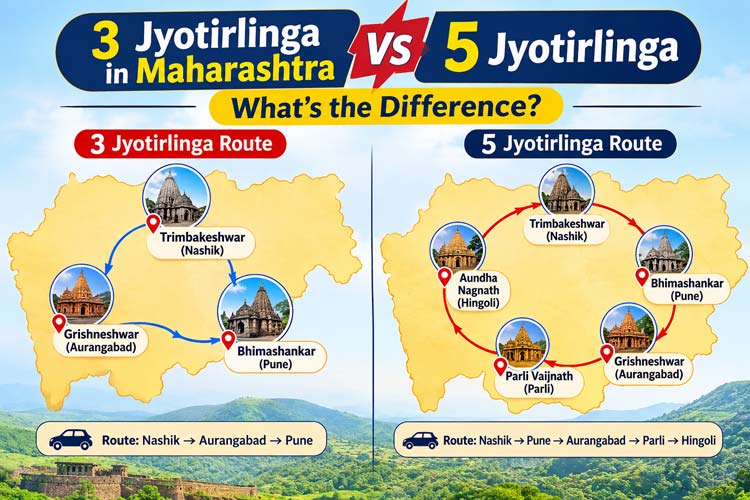
3 Jyotirlinga in Maharashtra vs 5 Jyotirlinga – What's the Difference?
🙏 Quick Facts
Maharashtra is traditionally known for 5 sacred Jyotirlingas of Lord Shiva, but many pilgrims talk about a tour of three Jyotirlingas. This guide explains the difference between the two types of pilgrimage tours, the temples each one covers, their religious significance, travel requirements, how to plan the route and how to choose the right Maharashtra Jyotirlinga tour.
Quick answer: A 3 Jyotirlinga tour covers Bhimashankar, Trimbakeshwar and Grishneshwar in about 3 days. A 5 Jyotirlinga tour adds Aundha Nagnath and Parli Vaijnath in the Marathwada region and needs about 4 days on a fast schedule (6–7 days at a relaxed pace). Choose 3 if you are short on time; choose 5 if you want to complete all five Jyotirlingas of Maharashtra in one trip.
📋 Table of Contents
Introduction
Maharashtra is one of the most important places for the devotees of Lord Shiva in India. The state houses five of the twelve sacred Jyotirlingas and is a destination for pilgrims from all over the country. These temples are Bhimashankar, Trimbakeshwar, Grishneshwar, Aundha Nagnath and Parli Vaijnath.
But there are two different pilgrimage options, popularly known as the 3 Jyotirlinga tour and the 5 Jyotirlinga tour in Maharashtra. This can be confusing, especially for first-time visitors trying to figure out which temples are included in each package.
The main difference is the number of temples you visit on the trail. A three Jyotirlinga tour typically includes Bhimashankar, Trimbakeshwar and Grishneshwar. The five Jyotirlinga pilgrimage covers all five Jyotirlinga temples traditionally recognised in the state of Maharashtra.
Both are important spiritual experiences. The right choice depends on how many days you have to travel, your budget, the type of transportation you prefer and whether you want to visit all five temples in one pilgrimage.
How Many Jyotirlingas Are There in Maharashtra?
Maharashtra is traditionally associated with five Jyotirlingas dedicated to Lord Shiva. Every temple has its own religious history, mythology, architecture and importance to devotees.
| # | Jyotirlinga | Location | In 3 Jyotirlinga Tour? | In 5 Jyotirlinga Tour? |
|---|---|---|---|---|
| 1 | Bhimashankar | Sahyadri hills, Pune district | Yes | Yes |
| 2 | Trimbakeshwar | Trimbak, near Nashik | Yes | Yes |
| 3 | Grishneshwar | Verul, near Ellora Caves | Yes | Yes |
| 4 | Aundha Nagnath | Hingoli district | No | Yes |
| 5 | Parli Vaijnath | Parli, Beed district | No | Yes |
These 5 temples are the foundation of the Maharashtra five Jyotirlinga pilgrimage. Devotees can visit all five in one long journey or opt for a shorter combination depending on their travel plans.
What Is a 3 Jyotirlinga Tour in Maharashtra?
A 3 Jyotirlinga tour is a short pilgrimage to three main Shiva temples of Maharashtra. The usual combination is Bhimashankar, Trimbakeshwar and Grishneshwar.
This is the option for devotees who have limited holidays or who want a shorter journey. These temples are located in different parts of the state and can be linked by a planned road route. For a detailed route, read our guide on how to complete the 3 Jyotirlinga yatra.
1. Bhimashankar Jyotirlinga
The Bhimashankar Temple is located in the Sahyadri mountain ranges and is surrounded by forest landscapes. It is a major pilgrim centre for the devotees of Lord Shiva.
The temple is famous for its traditional architecture and spiritual ambience. It is also in a hilly area, which makes the journey attractive to those who like natural surroundings.
2. Trimbakeshwar Jyotirlinga
The Trimbakeshwar Temple is near Nashik and is closely associated with the holy Godavari River. The temple is famous for its unique three-faced Shiva Linga, traditionally associated with Brahma, Vishnu and Mahesh.
Devotees come to Trimbakeshwar for regular darshan and various religious rituals. The nearby Brahmagiri Hills add to the spiritual significance of the place.
3. Grishneshwar Jyotirlinga
The Grishneshwar Temple is at Verul, close to the famous Ellora Caves. It is traditionally believed to be the twelfth Jyotirlinga and is noted for its historical architecture and religious significance.
Pilgrims visiting the region may also visit the Ellora Caves and the Kailasa Temple.
What Is a 5 Jyotirlinga Tour in Maharashtra?
A 5 Jyotirlinga tour covers all five traditionally recognised Jyotirlinga temples in Maharashtra. This is a longer pilgrimage that touches the main Shiva shrines of the state.
Apart from Bhimashankar, Trimbakeshwar and Grishneshwar, this tour also includes Aundha Nagnath and Parli Vaijnath. See the full day-wise plan in our 5 Jyotirlinga tour 4-day itinerary with route map.
4. Aundha Nagnath Jyotirlinga
Aundha Nagnath Temple is situated in Hingoli district and is one of the important religious destinations of the Marathwada region. It is traditionally one of the five Jyotirlingas of Maharashtra.
The temple is known for its ancient stone architecture, religious traditions and association with Lord Shiva. The shrine is a frequent stop for pilgrims on longer Maharashtra Jyotirlinga pilgrimages.
5. Parli Vaijnath Jyotirlinga
Parli Vaijnath Temple is situated in Parli town of Beed district. It is another major Shiva pilgrimage centre, traditionally counted among the five Jyotirlingas of Maharashtra.
Devotees visit the temple throughout the year, but particularly during Mahashivratri and the holy month of Shravan. This addition makes the five-temple pilgrimage more complete.
🙏 Book a 3 or 5 Jyotirlinga Tour
Hotel, AC transport and darshan guidance included. 3 Jyotirlinga from ₹8,500 and 5 Jyotirlinga from ₹13,500 per person.
Difference Between 3 Jyotirlinga and 5 Jyotirlinga Tours
Both tours are centred on Lord Shiva’s sacred shrines but vary in temple coverage, duration, distance and overall travel requirements.
| Comparison | 3 Jyotirlinga Tour | 5 Jyotirlinga Tour |
|---|---|---|
| Number of temples | 3 | 5 |
| Temples covered | Bhimashankar, Trimbakeshwar, Grishneshwar | All five Maharashtra Jyotirlingas |
| Additional temples | Not included | Aundha Nagnath and Parli Vaijnath |
| Travel duration | About 3 days (2 nights / 3 days); 4 days at a relaxed pace | About 4 days (3 nights / 4 days); 6–7 days at a relaxed pace |
| Road distance (Pune round trip) | About 830 km | About 1,250–1,300 km |
| Travel planning | Relatively simple | Requires more detailed planning |
| Accommodation | Fewer overnight stops | More overnight stops |
| Suitable for | Short holidays and limited schedules | Extended pilgrimage |
| Overall experience | Three important Shiva shrines | Complete five-temple Maharashtra pilgrimage |
Duration and distance are approximate. Actual requirements depend on where you start, road conditions, darshan queues and sightseeing preferences.
Which Tour Is Better – 3 Jyotirlinga or 5 Jyotirlinga?
There are pros and cons to both pilgrimage options. Which is best depends on what you care about and how much time you have.
Choose the 3 Jyotirlinga Tour If
If your travel days are limited, or if you want to visit select Jyotirlingas without a long road journey, a three-temple pilgrimage is a good option. It may be better for:
- Families planning a short religious break.
- Older adults who prefer to minimise long-distance transfers.
- Travellers with restricted annual leave.
- First-time visitors to Maharashtra.
- Pilgrims who wish to visit the temples and sightseeing around the area.
Choose the 5 Jyotirlinga Tour If
The five-temple pilgrimage is perfect for devotees who want to visit all five traditionally recognised Jyotirlingas in Maharashtra. It may be better for:
- Devotees who are planning a full-fledged Shiva pilgrimage.
- Families with enough travel days.
- Groups travelling together in their own vehicle.
- Pilgrims who wish to visit all five temples in one trip.
- Travellers seeking a longer religious holiday.
If your primary goal is to cover the Maharashtra five Jyotirlinga pilgrimage, the five-temple option removes the need to plan a separate trip to Aundha Nagnath and Parli Vaijnath later.
Travel Route for a 3 Jyotirlinga Tour
You can connect Bhimashankar, Trimbakeshwar and Grishneshwar in one road journey:
Bhimashankar → Trimbakeshwar → Grishneshwar
The route can be varied depending on the starting point and transport plans. Allow enough time for the hilly road to Bhimashankar, temple darshan at Trimbakeshwar and sightseeing around Ellora. This combination is generally done in 3 to 4 days, depending on where you start and end the trip.
| Leg | Approx. Distance | Approx. Drive Time |
|---|---|---|
| Pune → Bhimashankar | 110 km | 3 hours |
| Bhimashankar → Trimbakeshwar | 240 km | 5–6 hours |
| Trimbakeshwar → Grishneshwar | 220 km | 5 hours |
| Grishneshwar → Pune | 260 km | 5–6 hours |
Travel Route for a 5 Jyotirlinga Tour
The five-temple pilgrimage is a longer journey, since Aundha Nagnath and Parli Vaijnath are in the Marathwada region. The suggested route sequence is:
Bhimashankar → Trimbakeshwar → Grishneshwar → Aundha Nagnath → Parli Vaijnath
This route links the five temples by a longer road journey. Travellers are advised to book overnight accommodation in advance and take enough breaks while driving. The temples can be covered in 4 days on a fast schedule, but families and senior citizens are more comfortable with 6–7 days.
| Extra Leg (after Grishneshwar) | Approx. Distance | Approx. Drive Time |
|---|---|---|
| Grishneshwar → Aundha Nagnath | 225 km | 5 hours |
| Aundha Nagnath → Parli Vaijnath | 125 km | 3 hours |
| Parli Vaijnath → Pune | 350 km | 7–8 hours |
Road distances are approximate and change with the route you take. Check live traffic and road conditions before you travel.
Estimated Travel Budget for Both Tours
The total price depends on the number of travellers, the type of vehicle, the hotel, the meals and the length of the trip. A private cab is usually more flexible, whereas sharing a vehicle can lower the cost of your trip. The table below gives a broad planning comparison.
| Expense Category | 3 Jyotirlinga Tour | 5 Jyotirlinga Tour |
|---|---|---|
| Transportation | Lower overall requirement | Higher overall requirement |
| Accommodation | Fewer hotel nights | More hotel nights |
| Meals | Depends on duration | Depends on duration |
| Local transfers | Limited | More extensive |
| Total budget | Comparatively economical | Usually higher |
| Our package price (group of 6+) | From ₹8,500 per person | From ₹13,500 per person |
Check the total number of days, vehicle type, hotel category and group size before selecting a tour package to get an accurate travel budget. If you want to add Sai Baba darshan, look at our Shirdi with 3 Jyotirlinga tour from Pune.
Conclusion
The main difference between the 3 Jyotirlinga tour and the 5 Jyotirlinga tour in Maharashtra is the number of Jyotirlinga temples visited. The shorter option generally includes Bhimashankar, Trimbakeshwar and Grishneshwar, while the longer pilgrimage also includes Aundha Nagnath and Parli Vaijnath.
If you are short of time, the three-temple tour is a good option, whereas the five-temple tour is perfect for devotees who want to visit all five traditionally recognised Jyotirlingas of Maharashtra. Choose your pilgrimage according to the days available, your travel preferences and budget, and check the best time to visit the Jyotirlingas in Maharashtra before you book.
Plan Your Trip
FAQs About 3 Jyotirlinga vs 5 Jyotirlinga Tours
Maharashtra is traditionally known to have five Jyotirlingas – Bhimashankar, Trimbakeshwar, Grishneshwar, Aundha Nagnath and Parli Vaijnath.
A three-Jyotirlinga tour usually covers Bhimashankar, Trimbakeshwar and Grishneshwar. A five-Jyotirlinga tour includes these three temples along with Aundha Nagnath and Parli Vaijnath.
The three most chosen temples are Bhimashankar, Trimbakeshwar and Grishneshwar.
The five temples are Bhimashankar, Trimbakeshwar, Grishneshwar, Aundha Nagnath and Parli Vaijnath.
About 3 days (2 nights / 3 days) from Pune, or 4 days at a relaxed pace, depending on the starting point, the mode of transport and the time required for darshan.
All five temples can be covered in about 4 days (3 nights / 4 days) on a fast road schedule. For a comfortable pilgrimage with elders, plan 6 to 7 days.
Both work well for families. If your holiday is shorter, a three-temple tour is a convenient choice. If your family has more travel days available, a five-temple tour is a better option.
Yes. The five-temple tour involves more road travel, accommodation nights, meals and transport costs. Our packages start at ₹8,500 per person for 3 Jyotirlingas and ₹13,500 per person for 5 Jyotirlingas (group of 6 or more).
Yes, senior citizens can visit all five temples with comfortable transportation, suitable accommodation, regular rest breaks and a relaxed travel schedule.
Grishneshwar Jyotirlinga Temple is situated near the Ellora Caves in Verul, Maharashtra.